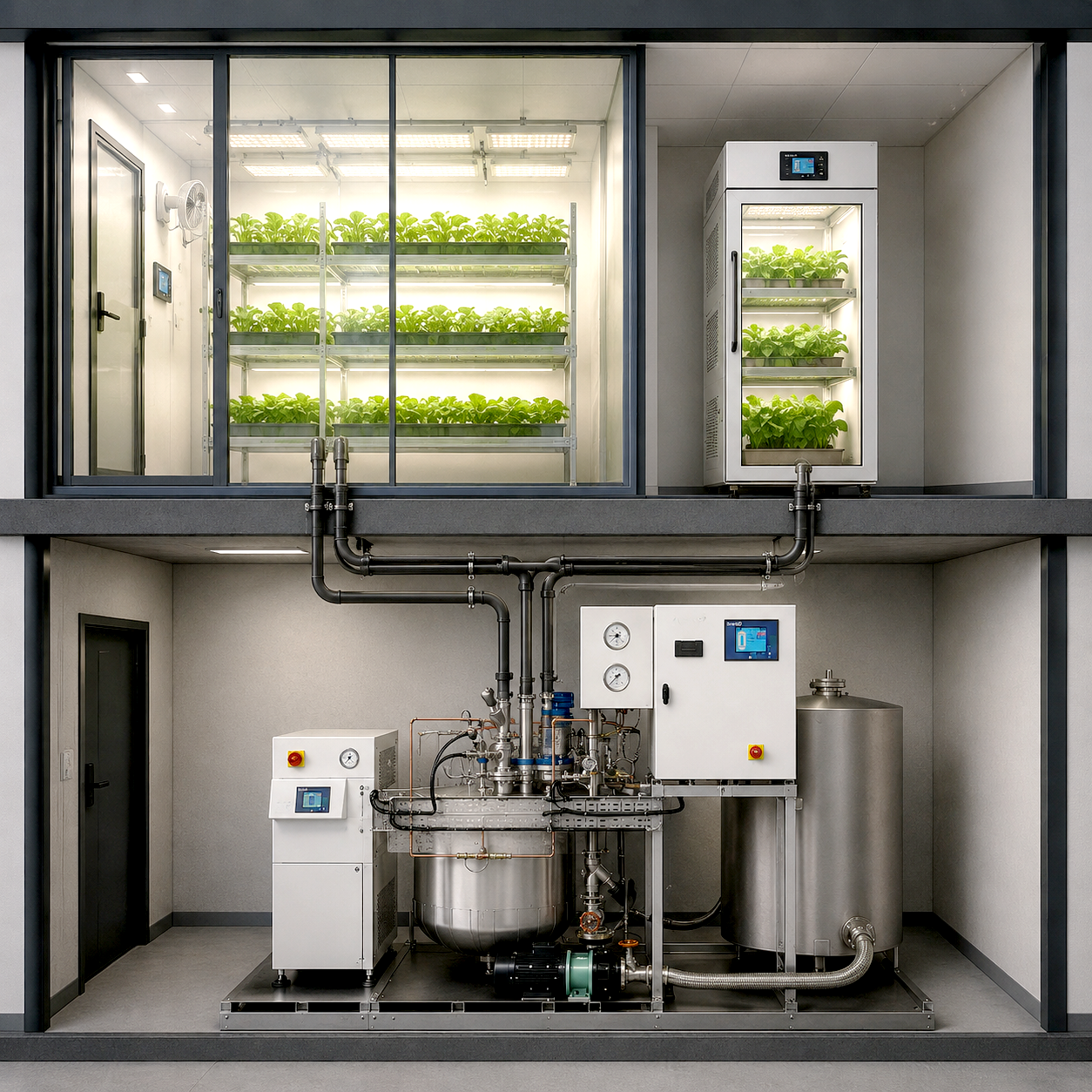
Plant growth cabinets, chambers, and walk-in rooms underpin a vast range of modern plant science — from fundamental biology and crop improvement, through phytopathology and quarantine pest studies, to the development of genetically modified varieties for food security, pharmaceutical, and industrial applications. What unites these systems, regardless of scale, is the principle of the controlled environment: temperature, humidity, light, CO₂, and airflow precisely managed to deliver reproducible conditions for the plants within.
Yet for facilities working with regulated organisms, control of the environment is only part of the story. What enters the chamber must, eventually, leave it. And while the plants themselves and their associated solid waste are relatively straightforward to manage through bagging and autoclaving, liquid effluent presents a more subtle and persistent challenge.
A spectrum of scales — and a spectrum of waste streams
Plant growth facilities span an enormous range of sizes. At one end, small benchtop cabinets support tissue culture and seedling studies in a footprint not much larger than a domestic appliance. At the other, walk-in growth rooms house entire research populations, with internal volumes measured in tens of cubic metres. Reach-in chambers occupy the middle ground, popular for medium-throughput phenotyping and pathology work.
Each of these generates liquid waste, though the volumes and sources vary:
• Irrigation and hydroponic effluent, where systems are not fully recirculating or where periodic flushing and nutrient resets are required
• Condensate from cooling coils and humidity control systems, which can run continuously and accumulate significant volumes over the course of an experiment
• Cleaning and decontamination water generated between experimental runs, between batches, or as part of routine facility hygiene
• Substrate leachate from soil- or media-grown plants where free drainage is permitted
In facilities working with genetically modified plants, plant pathogens, or notifiable pests, all of these streams are potentially subject to regulation. In the EU, Directive 2009/41/EC on the contained use of GMOs requires that liquid waste be appropriately inactivated before release to the wider environment, with stringency increasing alongside containment level. Plant Health legislation — administered in the UK by DEFRA and in the EU under Regulation 2016/2031 — applies analogous principles to plant pests and pathogens held under licence, with comparable frameworks operated by USDA APHIS in the United States and equivalent national authorities elsewhere.
The containment paradox
Plant growth facilities are designed, fundamentally, to keep things in. Seals, airlocks, HEPA-filtered ventilation, and interlocked doors all serve this purpose. Liquid waste pathways, however, can quietly form a counter-current — a route by which the carefully contained interior connects to the building's general drainage. Where wastewater leaves a sealed chamber, the chain of containment depends entirely on what happens next.
The classic answer has been collection by hand: catching effluent in vessels, decanting it into autoclave-safe containers, and processing it through a standard chamber autoclave. This works, but it reintroduces the very risks that containment is meant to eliminate. Open vessels can spill. Manual transfers expose staff to potentially contaminated material and hot liquids. And as facility size grows, the volumes involved quickly exceed what is practical to handle by hand. Chemical disinfection is a frequent fallback, but it brings its own drawbacks: contact time, storage of partly-treated liquids, residual chemistry entering the waste stream, and exposure of staff to disinfectant.
Automated decontamination, sized to the facility
A more elegant approach is to integrate sterilization directly into the facility's drainage. Liquid waste autoclaves (LWAs) and thermal effluent decontamination systems (TEDSs) sit in line with the wastewater stream, collecting effluent automatically, sterilizing it under heat and pressure, and discharging the treated liquid to sewer — all without manual intervention and without breaking containment. The sterilization process itself is identical to that used in a conventional autoclave: validated heat and pressure, with the option of spore-based biological indication where confirmation is required. The difference lies in eliminating the door, the manual transfer, and the open container — and with them, the points at which contained material is most likely to escape.
Because plant growth facilities themselves vary so widely in scale, the equipment that supports them must do the same. A single cabinet running occasional flushes generates dramatically different volumes from a walk-in room with continuous hydroponics and active humidity control. The AstellBio range reflects this, with compact units such as the AstellBio Micro EDS well suited to individual cabinets or condensate streams from small chambers, mid-capacity LWAs serving suites of reach-in units, and larger TEDSs capable of processing the combined output of entire growth-room facilities — thousands of litres per day where required.
Building it in from the start
For facility managers planning new plant growth installations — or upgrading existing ones — considering liquid waste at the design stage is considerably simpler than retrofitting later. Drainage routes, plinth locations, power and water supply, and chemical-free operation can all be specified up front, with the decontamination system sized to current needs and future expansion in mind.
Contact AstellBio to discuss how a liquid waste autoclave or effluent decontamination system can support the safe, compliant, and fully automated operation of your plant growth cabinets, chambers, or rooms.