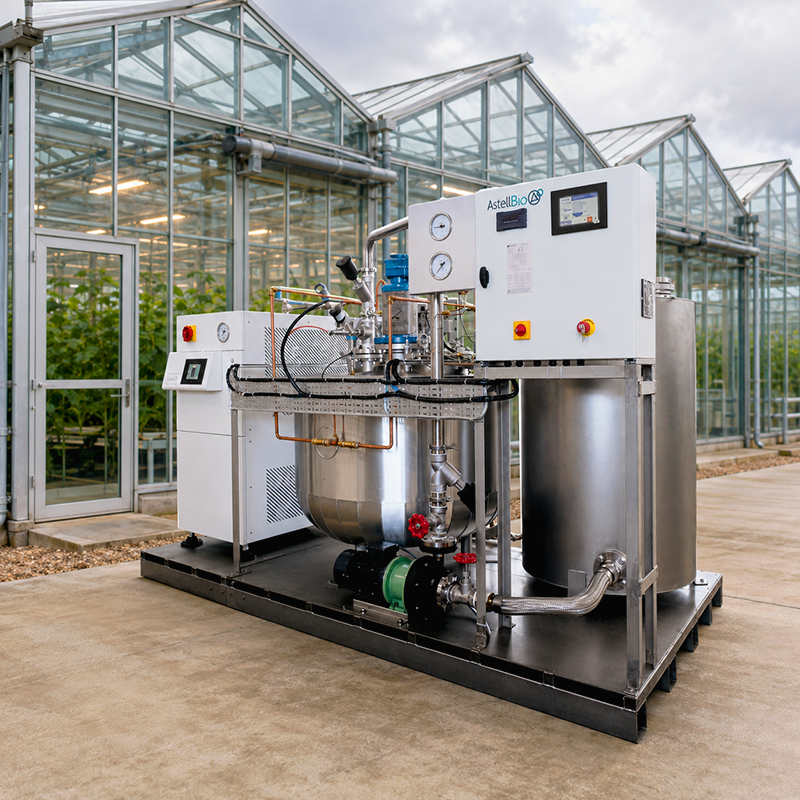
As the climate grows less predictable, genetic research on crops — for drought resistance, heat tolerance and the protection of yields — is increasingly seen as part of how global food security might be safeguarded. Much of that science depends on an unglamorous necessity: the biological waste it generates has to be contained and reliably decontaminated before it can leave the building. Treating that waste safely is precisely the need this project set out to meet.
The customer is one of the UK's leading independent institutes for plant science, genetics and microbiology. Much of its research examines how plants and the microbes around them interact — how bacterial and fungal pathogens cause disease, and how crops resist it — work that bears directly on agriculture and food security. Some of this is carried out with genetically modified plants and micro-organisms inside Containment Level 2 glasshouses, an activity governed by plant health licences issued by the relevant national regulator.
Waste water generated by the glasshouse — between 200 and 300 litres per day — had to be reliably decontaminated before it could be released, so that no viable micro-organisms could enter the environment. The institute needed a system that would provide a validated thermal kill, integrate with the available services and physical space on site, and satisfy the scrutiny of the regulator's plant health inspectors.
This was not a one-off obligation. The institute's containment glasshouses generate regulated run-off as an ongoing part of their work, and its established approach had been to treat such water chemically — collecting it in a holding tank, dosing with sodium hypochlorite, then neutralising with sodium thiosulfate before filtration and discharge. Moving to a validated thermal process gave the institute a defined, repeatable kill that it could evidence to its inspectors.
The institute approached Astell Scientific to specify and cost a thermal decontamination unit. As the institute's facilities contact set out at the start of the project:
“We are investigating options for the treatment of our waste water from our Containment Level 2 glasshouse used for the growth of genetically modified plants and micro-organisms. We would be looking for a system capable of dealing with 200–300 litres of waste water per day.”
Facilities & Risk Management contact, the institute